
Caesar Archivum

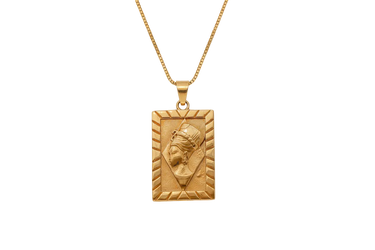
Nefertiti Pendant

$219.00
Tax included. Shipping calculated at checkout.
Material: Gold

Introducing the Nefertiti Pendant, an exquisite handcrafted piece designed by @taniberlo. Each pendant is unique due to its handmade nature.

Inspired by the legendary beauty and leadership of ancient Egyptian queen Nefertiti from the 14th century BC, this necklace pays homage to her iconic legacy and the rich history of Egypt.

Embrace boldness and sophistication with the Nefertiti pendant, a statement piece that exudes confidence and glamour. Add a touch of ancient allure to your style and embrace the power of a legendary queen.

Historical Context

Nefertiti was Great Royal Wife of Akhenaten (Amenhotep IV), pharaoh of the Eighteenth Dynasty, who reigned 1353 to 1336 BCE. Together they instituted the Amarna religious reform. The worship of a single solar god, the Aten, displacing the older Egyptian polytheism. They built a new capital at Akhetaten (modern Amarna). The reform did not outlast them. Their successor Tutankhamun returned Egypt to the old gods.

The famous painted limestone bust of Nefertiti was found in the workshop of the sculptor Thutmose at Amarna in 1912. It is now in the Neues Museum in Berlin. Her tomb has never been found.

Symbolic Meaning

Nefertiti. The beautiful one has come. The Amarna reform. Egyptian queenship. The iconic profile.

Nefertiti's name means "the beautiful one has come". She ruled alongside her husband Akhenaten in the fourteenth century BCE, was elevated to co regent, and may have ruled briefly alone after his death under the name Neferneferuaten.

To wear her profile is to align with one of the very few women in antiquity who held real political power in her own right.

Wearers Intention

For the long game queens. Nefertiti's reign was a religious revolution. Her husband Akhenaten attempted to remake Egyptian religion around a single sun god. The reform did not survive him. The pendant is for the wearers playing for stakes that may not pay out in their lifetime.

For the profile makers. The Berlin bust of Nefertiti, sculpted around 1340 BCE, is one of the most reproduced female faces in human history. The pendant carries that profile. The long neck, the high cheekbone, the flat topped crown.

Care Guide

For Silver:
Clean with warm water, mild soap, and a soft cloth. Polish with a silver cloth as needed. The sculpted profile will hold a darker patina in its grooves. Most wearers prefer this aged look.

For Gold:
Wipe with a soft cloth after wear. Wash periodically with warm water and mild soap. Avoid chlorine and perfume.

General:
Remove before sleep, exercise, and showering. Store flat in a soft pouch.

Material: Gold