1 2

Caesar Archivum

The Lunula Stud

$215.00
Tax included. Shipping calculated at checkout.

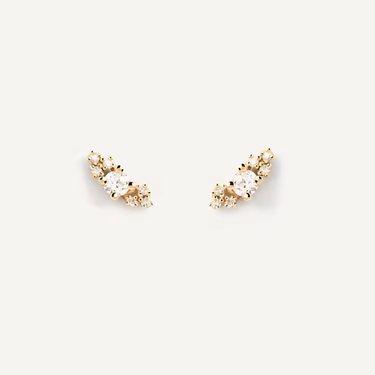
The lunula — a crescent of gold worn at the throat — was among the earliest talismanic ornaments of the ancient world. This miniature rendering captures that same celestial arc, set with a trail of white stones that follow the moon's curve.

Cast in 925 sterling silver.

Stack note
Wears at the upper lobe or helix. Forms the celestial tier of the ear stack.

Historical Context

The lunula is among the oldest forms of European jewellery. Bronze Age examples, thin sheets of gold beaten into a crescent collar, have been recovered from Ireland, Cornwall, and the Atlantic coast of France, dating from around 2200 to 1800 BCE. The form was widespread enough that archaeologists count over a hundred surviving Irish examples alone, now held in the National Museum of Ireland.

The Romans inherited the form. Roman lunulae were small crescent amulets given to children at birth, worn at the throat as protection. The Latin verb praefari, to invoke, was applied to the act of placing one on a newborn. Pliny the Elder mentions the practice in the first century CE. The lunula remained a domestic protective object across the Roman world for five hundred years.

This stud is a domestic scale return to that very old form.

Symbolic Meaning

The crescent. The waxing moon. The lunula. Cyclical time. Quiet beginnings.

The lunula, little moon, carries the symbolism of cyclical time. Where the sun is fixed, the moon changes. Where solar emblems mark authority, lunar emblems mark return.

To wear the crescent is to align with what comes back rather than what stays still.

Wearers Intention

For the moon trackers. If you know what phase the moon is in tonight without checking. If your cycle, your sleep, or your moods feel tied to it. The lunula is the original moon keeping piece.

For the upper lobe stackers. The Lunula sits at the helix or the upper lobe, where it forms the celestial tier of an ear stack. Pairs with the Cassini Constellation Stud at the first lobe, the Hyades below.

For those marking a beginning. The crescent moon is, traditionally, the moon of new beginnings. Wear it as a marker of something just started. A project, a pregnancy, a return.

Care Guide

Stones:
The stones are pavé set along the inner curve. Avoid knocking the stud against hard surfaces and remove before sleep, exercise, and showering.

For Silver:
Clean with warm water, mild soap, and a soft cloth. Use a soft brush very gently along the stone trail to release trapped dust. Polish with a silver cloth.

General:
Store flat in a soft pouch. The crescent shape is fine. Do not bend or pull at the curve.